Several chapters in various books concerning California Real Estate Finance list reasons for past lending failures. When you take the time to read these reasons, they tend to put the onus on the purchaser. I am going to take a different approach. My opinion is that greed was a major cause of these failures. All a person has to do is sign their name to receive a loan. When loans are offered without proof of the signer’s financial stability, there is a high risk that someone may wish to take advantage of the borrower. Greed is involved. It is popular today to blame the crash of 2008 on the deregulation of lending institutions. It seems that once sufficient time has passed, our politicians tend to rewrite history. Today, our children are taught that President Roosevelt’s New Deal ended the Great Depression when the Great Depression did not end until after WWII, and his policies had been abandoned.
Another tactic used is redefining a term. According to Investopedia, depression is:
“A depression is a severe and prolonged downturn in economic activity. A depression is an extreme recession that lasts three or more years or leads to a decline in actual gross domestic product (GDP) of at least 10% in a given year.
However, just two paragraphs past that definition, the author claims:
” The U.S. has experienced at least 34 recessions since 1850, including, in recent years, the Great Recession of 2008-2009 and the Covid recession of 2020. But it has had only one depression, which lasted from 1929 until 1939 and is known as the Great Depression.
”https://www.investopedia.com/terms/d/depression.asp
Our economy is still paying for the blunders from the Great Recession, which, if happened earlier, would have been declared a Depression.
During the time of this banking deregulation, some interesting regulations were added to the lending institution:
- The Privacy Act
https://www.justice.gov/opcl/overview-privacy-act-1974-2020-edition/introduction
Introduction
The Privacy Act of 1974, Pub Law No. 93-579, 88 Stat 1896 (Dec. 31, 1974), codified at 5 U.S.C. § 552a (2018), went into effect on September 27, 1975, when it became the principal law governing the handling of personal information in the federal government. Enacted in the wake of the Watergate and the Counterintelligence Program (COINTELPRO) scandals involving illegal surveillance of opposition political parties and individuals deemed to be “subversive,” the Privacy Act sought to restore trust in government and to address what at the time was seen as an existential threat to American democracy. In the words of the bill’s principal sponsor, Judiciary Chairman Senator Sam Ervin, “[i]f we have learned anything in this last year of Watergate, it is that there must be limits upon what the Government can know about each of its citizens.” See S. Comm. on Gov’t. Operations & H.R. Comm. on Gov’t. Operations, 94th Cong., Legislative History of the Privacy Act of 1974 S. 3418 (Public Law 93-579): Source Book on Privacy at 4 (Comm. Print 1976) [hereinafter Source Book], https://www.justice.gov/opcl/paoverview_sourcebook.
- The Patriot Act
The Department of Justice’s first priority is to prevent future terrorist attacks. Since its passage following the September 11, 2001 attacks, the Patriot Act has played a key part -and often the leading role – in a number of successful operations to protect innocent Americans from the deadly plans of terrorists dedicated to destroying America and our way of life. While the results have been important, in passing the Patriot Act, Congress provided for only modest, incremental changes in the law. Congress simply took existing legal principles and retrofitted them to preserve the lives and liberty of the American people from the challenges posed by a global terrorist network.
The USA PATRIOT Act: Preserving Life and Liberty
(Uniting and Strengthening America by Providing Appropriate Tools Required to
Intercept and Obstruct Terrorism) Congress enacted the Patriot Act by overwhelming, bipartisan margins, arming law enforcement with new tools to detect and prevent terrorism: The USA Patriot Act was passed nearly unanimously by the Senate 98-1, and 357-66 in the House, with the support of members from across the political spectrum.
The Act Improves Our Counter-Terrorism Efforts in Several Significant Ways:
- The Patriot Act allows investigators to use the tools that were already available to investigate organized crime and drug trafficking. Many of the tools the Act provides to law enforcement to fight terrorism have been used for decades to fight organized crime and drug dealers, and have been reviewed and approved by the courts. As Sen. Joe Biden (D-DE) explained during the floor debate about the Act, “the FBI could get a wiretap to investigate the mafia, but they could not get one to investigate terrorists. To put it bluntly, that was crazy! What’s good for the mob should be good for terrorists.” (Cong. Rec.,
10/25/01)
• Allows law enforcement to use surveillance against more crimes of terror. Before the Patriot Act, courts could permit law enforcement to conduct electronic surveillance to investigate many ordinary, non-terrorism crimes, such as drug crimes, mail fraud, and passport fraud. Agents also could obtain wiretaps to investigate some, but not all, of the crimes that terrorists often commit. The Act enabled investigators to gather information when looking into the full range of terrorism-related crimes, including: chemical-weapons offenses, the use of weapons of mass destruction, killing Americans abroad, and terrorism financing.
• Allows federal agents to follow sophisticated terrorists trained to evade
- For years, law enforcement has been able to use “roving wiretaps” to investigate ordinary crimes, including drug offenses and racketeering. A roving wiretap can be authorized by a federal judge to apply to a particular suspect, rather than a particular phone or communications device. Because international terrorists are sophisticated and trained to thwart surveillance by rapidly changing locations and communication devices such as cell phones, the Act authorized agents to seek court permission to use the same techniques in national security investigations to track terrorists.
• Allows law enforcement to conduct investigations without tipping off
- In some cases, if criminals are tipped off too early to an investigation, they might flee, destroy evidence, intimidate or kill witnesses, cut off contact with associates, or take other action to evade arrest. Therefore, federal courts in narrow circumstances long have allowed law enforcement to delay for a limited time when the subject is told that a judicially-approved search warrant has been
- Notice is always provided, but the reasonable delay gives law
enforcement time to identify the criminal’s associates, eliminate immediate threats to our communities, and coordinate the arrests of multiple individuals without tipping them off beforehand. These delayed notification search warrants have been used for decades, have proven crucial in drug and organized crime cases, and have been upheld by courts as fully constitutional.
• Allows federal agents to ask a court for an order to obtain business records in national security terrorism cases. Examining business records often provides the key that investigators are looking for to solve a wide range of crimes. Investigators might seek select records from hardware stores or chemical plants, for example, to find out who bought materials to make a bomb, or bank records to see who’s sending money to terrorists. Law enforcement authorities have always been able to obtain business records in criminal cases through grand jury subpoenas, and continue to do so in national security cases where appropriate. These records were sought in criminal cases such as the investigation of the
Zodiac gunman, where police suspected the gunman was inspired by a Scottish occult poet, and wanted to learn who had checked the poet’s books out of the
- In national security cases where use of the grand jury process was not appropriate, investigators previously had limited tools at their disposal to obtain certain business records. Under the Patriot Act, the government can now ask a federal court (the Foreign Intelligence Surveillance Court), if needed to aid an investigation, to order production of the same type of records available through grand jury subpoenas. This federal court, however, can issue these orders only after the government demonstrates the records concerned are sought for an authorized investigation to obtain foreign intelligence information not concerning a U.S. person or to protect against international terrorism or clandestine intelligence activities, provided that such investigation of a U.S. person is not conducted solely on the basis of activities protected by the First Amendment.
- The Patriot Act facilitated information sharing and cooperation among government agencies so that they can better “connect the dots.” The Act removed the major legal barriers that prevented the law enforcement, intelligence, and national defense communities from talking and coordinating their work to protect the American people and our national security. The government’s prevention efforts should not be restricted by boxes on an organizational chart. Now police officers, FBI agents, federal prosecutors and intelligence officials can protect our communities by “connecting the dots” to uncover terrorist plots before they are completed. As Sen. John Edwards (D- N.C.) said about the Patriot Act, “we simply cannot prevail in the battle against terrorism if the right hand of our government has no idea what the left hand is doing.” (Press release, 10/26/01)
• Prosecutors and investigators used information shared pursuant to section 218 in investigating the defendants in the so-called “Virginia Jihad” case. This prosecution involved members of the Dar al-Arqam Islamic Center, who trained or jihad in Northern Virginia by participating in paintball and paramilitary training, including eight individuals who traveled to terrorist training camps in Pakistan or Afghanistan between 1999 and 2001. These individuals are associates of a violent Islamic extremist group known as Lashkar-e-Taiba (LET), which
operates in Pakistan and Kashmir, and that has ties to the al Qaeda terrorist
- As the result of an investigation that included the use of information
obtained through FISA, prosecutors were able to bring charges against these
2.Six of the defendants have pleaded guilty, and three were convicted
in March 2004 of charges including conspiracy to levy war against the United States and conspiracy to provide material support to the Taliban. These nine defendants received sentences ranging from a prison term of four years to life imprisonment.
- The Patriot Act updated the law to reflect new technologies and new threats. The Act brought the law up to date with current technology, so we no longer have to fight a digital-age battle with antique weapons-legal authorities’ leftover from the era of rotary
- When investigating the murder of Wall Street Journal reporter Daniel Pearl, for example, law enforcement used one of the Act’s new authorities to use high-tech means to identify and locate some of the killers.
• Allows law enforcement officials to obtain a search warrant anywhere a
terrorist-related activity occurred. Before the Patriot Act, law enforcement
personnel were required to obtain a search warrant in the district where they intended to conduct a search. However, modern terrorism investigations often span a number of districts, and officers therefore had to obtain multiple warrants in multiple jurisdictions, creating unnecessary delays. The Act provides that warrants can be obtained in any district in which terrorism-related activities occurred, regardless of where they will be executed. This provision does not change the standards governing the availability of a search warrant, but streamlines the search-warrant process.
• Allows victims of computer hacking to request law enforcement assistance in monitoring the “trespassers” on their computers. This change made the law technology-neutral; it placed electronic trespassers on the same footing as physical trespassers. Now, hacking victims can seek law enforcement assistance to combat hackers, just as burglary victims have been able to invite officers into their homes to catch burglars.
3.The Patriot Act increased the penalties for those who commit terrorist crimes. Americans are threatened as much by the terrorist who pays for a bomb as by the one who pushes the button. That’s why the Patriot Act imposed tough new penalties on those who commit and support terrorist operations, both at home and abroad. In particular, the Act:
• Prohibits the harboring of terrorists. The Act created a new offense that
prohibits knowingly harboring persons who have committed or are about to commit a variety of terrorist offenses, such as: destruction of aircraft; use of nuclear, chemical, or biological weapons; use of weapons of mass destruction; bombing of government property; sabotage of nuclear facilities; and aircraft piracy.
• Enhanced the inadequate maximum penalties for various crimes likely to be committed by terrorists: including arson, destruction of energy facilities, material support to terrorists and terrorist organizations, and destruction of national-defense materials.
• Enhanced a number of conspiracy penalties, including for arson, killings in federal facilities, attacking communications systems, material support to terrorists, sabotage of nuclear facilities, and interference with flight crew
4.Under previous law, many terrorism statutes did not specifically
prohibit engaging in conspiracies to commit the underlying offenses. In such cases, the government could only bring prosecutions under the general federal conspiracy provision, which carries a maximum penalty of only five years in prison.
• Punishes terrorist attacks on mass transit systems.
• Punishes bioterrorists.
• Eliminates the statutes of limitations for certain terrorism crimes and
lengthens them for other terrorist crimes.
The government’s success in preventing another catastrophic attack on the American homeland since September 11, 2001, would have been much more difficult, if not impossible, without the USA Patriot Act. The authorities Congress provided have substantially enhanced our ability to prevent, investigate, and prosecute acts of terror.
- Sarbanes & Oxley
https://www.sec.gov/about/about-securities-laws
Fast Answers The Laws That Govern the Securities Industry
Note: Except as otherwise noted, the links to the securities laws below are from Statute Compilations maintained by the Office of the Legislative Counsel, U.S. House of Representatives. These links are provided for the user’s convenience and may not reflect all recent amendments. Users may also want to consult the U.S. Code by referencing the Popular Name Table. For questions concerning the meaning or application of a particular law, please consult with an attorney who specializes in securities law.
Securities Act of 1933
Often referred to as the “truth in securities” law, the Securities Act of 1933 has two basic objectives:
· require that investors receive financial and other significant information concerning securities being offered for public sale; and
· prohibit deceit, misrepresentations, and other fraud in the sale of securities.
See the full text of the Securities Act of 1933.
Purpose of Registration
A primary means of accomplishing these goals is the disclosure of important financial information through the registration of securities. This information enables investors, not the government, to make informed judgments about whether to purchase a company’s securities. While the SEC requires that the information provided be accurate, it does not guarantee it. Investors who purchase securities and suffer losses have important recovery rights if they can prove that there was incomplete or inaccurate disclosure of important information.
The Registration Process
In general, securities sold in the U.S. must be registered. The registration forms companies file provide essential facts while minimizing the burden and expense of complying with the law. In general, registration forms call for:
· a description of the company’s properties and business;
· a description of the security to be offered for sale;
· information about the management of the company; and
· financial statements certified by independent accountants.
Registration statements and prospectuses become public shortly after filing with the SEC. If filed by U.S. domestic companies, the statements are available on the EDGAR database accessible at http://www.sec.gov. Registration statements are subject to examination for compliance with disclosure requirements.
Not all offerings of securities must be registered with the Commission. Some exemptions from the registration requirement include:
· private offerings to a limited number of persons or institutions;
· offerings of limited size;
· intrastate offerings; and
· securities of municipal, state, and federal governments.
By exempting many small offerings from the registration process, the SEC seeks to foster capital formation by lowering the cost of offering securities to the public.
Securities Exchange Act of 1934
With this Act, Congress created the Securities and Exchange Commission. The Act empowers the SEC with broad authority over all aspects of the securities industry. This includes the power to register, regulate, and oversee brokerage firms, transfer agents, and clearing agencies, as well as the nation’s securities self-regulatory organizations (SROs). The various securities exchanges, such as the New York Stock Exchange, the NASDAQ Stock Market, and the Chicago Board of Options are SROs. The Financial Industry Regulatory Authority (FINRA) is also an SRO.
The Act also identifies and prohibits certain types of conduct in the markets and provides the Commission with disciplinary powers over regulated entities and persons associated with them.
The Act also empowers the SEC to require periodic reporting of information by companies with publicly traded securities.
See the full text of the Securities Exchange Act of 1934.
Corporate Reporting
Companies with more than $10 million in assets whose securities are held by more than 500 owners must file annual and other periodic reports. These reports are available to the public through the SEC’s EDGAR database.
Proxy Solicitations
The Securities Exchange Act also governs the disclosure in materials used to solicit shareholders’ votes in annual or special meetings held for the election of directors and the approval of other corporate action. This information, contained in proxy materials, must be filed with the Commission in advance of any solicitation to ensure compliance with the disclosure rules. Solicitations, whether by management or shareholder groups, must disclose all important facts concerning the issues on which holders are asked to vote.
Tender Offers
The Securities Exchange Act requires disclosure of important information by anyone seeking to acquire more than 5 percent of a company’s securities by direct purchase or tender offer. Such an offer often is extended in an effort to gain control of the company. As with the proxy rules, this allows shareholders to make informed decisions on these critical corporate events.
Insider Trading
The securities laws broadly prohibit fraudulent activities of any kind in connection with the offer, purchase, or sale of securities. These provisions are the basis for many types of disciplinary actions, including actions against fraudulent insider trading. Insider trading is illegal when a person trades a security while in possession of material nonpublic information in violation of a duty to withhold the information or refrain from trading.
Registration of Exchanges, Associations, and Others
The Act requires a variety of market participants to register with the Commission, including exchanges, brokers and dealers, transfer agents, and clearing agencies. Registration for these organizations involves filing disclosure documents that are updated on a regular basis.
The exchanges and the Financial Industry Regulatory Authority (FINRA) are identified as self-regulatory organizations (SRO). SROs must create rules that allow for disciplining members for improper conduct and for establishing measures to ensure market integrity and investor protection. SRO proposed rules are subject to SEC review and published to solicit public comment. While many SRO proposed rules are effective upon filing, some are subject to SEC approval before they can go into effect.
Trust Indenture Act of 1939
This Act applies to debt securities such as bonds, debentures, and notes that are offered for public sale. Even though such securities may be registered under the Securities Act, they may not be offered for sale to the public unless a formal agreement between the issuer of bonds and the bondholder, known as the trust indenture, conforms to the standards of this Act.
See the full text of the Trust Indenture Act of 1939.
Investment Company Act of 1940
This Act regulates the organization of companies, including mutual funds, that engage primarily in investing, reinvesting, and trading in securities, and whose own securities are offered to the investing public. The regulation is designed to minimize conflicts of interest that arise in these complex operations. The Act requires these companies to disclose their financial condition and investment policies to investors when stock is initially sold and, subsequently, on a regular basis. The focus of this Act is on disclosure to the investing public of information about the fund and its investment objectives, as well as on investment company structure and operations. It is important to remember that the Act does not permit the SEC to directly supervise the investment decisions or activities of these companies or judge the merits of their investments.
See the full text of the Investment Company Act of 1940.
Investment Advisers Act of 1940
This law regulates investment advisers. With certain exceptions, this Act requires that firms or sole practitioners compensated for advising others about securities investments must register with the SEC and conform to regulations designed to protect investors. Since the Act was amended in 1996 and 2010, generally only advisers who have at least $100 million of assets under management or advise a registered investment company must register with the Commission.
See the full text of the Investment Advisers Act of 1940.
Sarbanes-Oxley Act of 2002
On July 30, 2002, President Bush signed into law the Sarbanes-Oxley Act of 2002, which he characterized as “the most far reaching reforms of American business practices since the time of Franklin Delano Roosevelt.” The Act mandated a number of reforms to enhance corporate responsibility, enhance financial disclosures and combat corporate and accounting fraud, and created the “Public Company Accounting Oversight Board,” also known as the PCAOB, to oversee the activities of the auditing profession. (Please check the Classification Tables maintained by the US House of Representatives Office of the Law Revision Counsel for updates to any of the laws.) You can find links to all Commission rulemaking and reports issued under the Sarbanes-Oxley Act at: http://www.sec.gov/spotlight/sarbanes-oxley.htm.
See the full text of the Sarbanes-Oxley Act of 2002.
Dodd-Frank Wall Street Reform and Consumer Protection Act of 2010
The Dodd-Frank Wall Street Reform and Consumer Protection Act was signed into law on July 21, 2010 by President Barack Obama. The legislation set out to reshape the U.S. regulatory system in a number of areas including but not limited to consumer protection, trading restrictions, credit ratings, regulation of financial products, corporate governance and disclosure, and transparency. (Please check the Classification Tables maintained by the US House of Representatives Office of the Law Revision Counsel for updates to any of the laws.) You can find links to all Commission rulemaking and reports issued under the Dodd Frank Act at: http://www.sec.gov/spotlight/dodd-frank.shtml.
See the full text of the Dodd-Frank Wall Street Reform and Consumer Protection Act of 2010.
Jumpstart Our Business Startups Act of 2012
The Jumpstart Our Business Startups Act (the “JOBS Act”) was enacted on April 5, 2012. The JOBS Act aims to help businesses raise funds in public capital markets by minimizing regulatory requirements. The full text of the Act is available at: http://www.gpo.gov/fdsys/pkg/BILLS-112hr3606enr/pdf/BILLS-112hr3606enr.pdf. (Please check the Classification Tables maintained by the US House of Representatives Office of the Law Revision Counsel for updates to any of the laws.)
After looking at those regulations which have been added since the 1970’s, I have had difficulty in finding the period of Deregulation; however, there has been a time of mis-regulation.
At the turn of the century, the Fed had some minor economic conditions which needed corrections. Alen Greenspan was on the downhill side of his time as the chairmen of the Federal Reserve. He served from 1987 through 2006. He did not want these minor issues to tarnish his name, so he printed money. But doing so created negative real interest rates. People and businesses could borrow borrowed at rates lower than our inflation rate.
I can remember people camping out in front of model homes and going in and purchases as many as they were permitted to. They never moved in. They put these locked-up houses, in the tract, back on the market, often by the same agent who sold them theirs. They made thousands of dollars on each unit during the process.
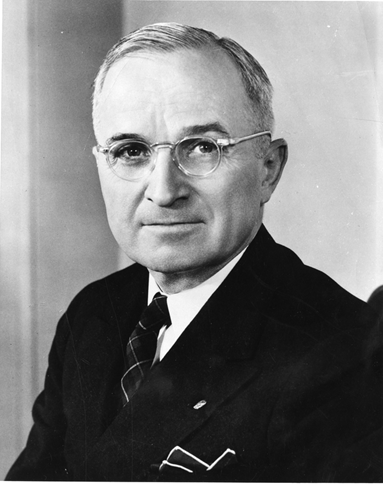
“Portrait of President Truman | Harry S. Truman
The bad news is we may heading for a 1980’s style housing market which many economist predict. If they’re correct, housing prices will fall a little during a brief two-year slowdown, but interest rates will climb. If they’re wrong, there will not be a two your slowdown in Real Estate, and prices with continue their climb while interest rate continues to climb. If that sounds a little two sided, it is because no one has a crystal ball that accurately predicts the future.
When FDR died and Harry Trueman became president, he soon was given the title of Plain-Speaking Harry. There is a story about how he kept the roses at the white house so beautiful. But once he asked his staff for something odd. HE requested a one-handed economist. After being to It will go like this…on the other hand, it will go like this. Harry Trueman also gave the definition of a recession and a depression: “
All this is to show that the government, banking institutions, and Insurance companies helped to create the 2008 recession. Things were said that tickled people’s ears. “Everyone has the right to have a home.” Everyone has the right to medical care. It sounds good, but it pays the bill for everyone.
This philosophy got the Race to the Bottom started. The phrase Race to the Bottom means a competitive situation where a company, state, or nation attempts to undercut the competitors’ prices by sacrificing quality standards or safety. Banks began competing with private lending institutions, and the Race to the Bottom was on. If you could sing your name, you could purchase a house. This institution knew it was risky, so they cut them up. They sold pieces of the same place 50 or so times. Then they insured it. However, depending on the ever-increasing money supply, the person who purchases a house beyond their means is at a greater risk of losing it. When it ran out, the institutions demanded their money or the property. They took the property. They filed the insurance claim and recovered because it was a government-insured loan. Usually, they did this more than once because they owned pieces of the house. Then, after foreclosing on the property often, they repurchased them for a quarter or so on the dollar.
Whose greed caused the crash. Was it the man struggling to put a roof over his loved ones’ heads, or was it the lending institutions, the government policymakers, and the insurance companies? There is a list of regulations which have now become law. Which one corrects a person purchasing a house? Who benefits from this? It is not the working man. Recently, more and more lenders are beginning to lend again without regard for prudent lending practices. Do not fall victim to these lenders. Take the time and prepare yourself for home-ownership. Do not become house-poor. If they can foreclose on your home, it will be a blemish, which is hard to overcome. Maybe not financially, but mentally, it is a burden many do not overwhelm. They take the house but ruin life’s dream in the process. They create a renter by necessity. They often swoop in and purchase these foreclosed properties at cut prices.
This blog has been longer than most, but it provides the information needed to make a sound financial decision. Make one that ten years from now will still put a smile on your face.
Note: Images on this blog site are from a free source. No image or group of photos are intended to represent the people I serve. I don’t care about Race (that is a politically correct term that I do not like because we are all of the same Race, the Human Race. I prefer the term ethnicity), color, religion, sex, gender, marital status, disability, genetic information, national origin, source of income, Veteran or military status, ancestry, citizenship, primary language or immigration status. I am a service provider for all people. We will all rise together when we band together and help one another. Joseph Erwin is a Real Estate Broker, DRE # O2131799, and a CA general contractor # B 696662. He’s a member of the CRMLS and The East Valley Association of Realtors located in the Inland Empire region of Southern California.
 House 2 Homes
Leave a comment