When discussing your finances and personal finance plan, a lot could be said about your credit. You need to check and continuously monitor your credit reports. Lenders will check your credit scores. These things should concern you because they affect your ability to get a loan, jobs, obtain a house, and even your insurance is affected by your creditworthiness. Credit is bringing something you need today and paying for it tomorrow. However, consumer credit is a person’s use of credit, but it does not include their home’s mortgage. Do not fall victim to advertisers’ traps such as “Life takes a Visa.” use a Visa wisely because living beyond your means can cause that Visa to take your life and give you an existence in its place. Please don’t get me wrong; credit can be a helpful tool.
Credit was used in colonial times; although it was a privilege extended only to the affluent of the time, farmers often used it. In its infancy, it did not involve finance charges as it does today; instead, the cost of credit was calculated into the overall price and paid off through installment payments. With the creation of the automobile, notably Henry Ford, and his speed of delivering his product installment credit, where debt is repaid through equal installments over a specified period, the American credit scene exploded.
Basically, there are two types of credit:
- Closed-end credit: This is when a person or entity borrows for a specific purpose, a home, a property, a car, a truck, equipment, and so forth. The amount borrowed is a set amount, and the scheduled payments reduce the loan amount until the balance has been paid in full.
- Open-end credit: This is credit that changes in the amount as it is used. The amount of this credit varies throughout the month. These are typically credit cards. Master cards, Visa, store cards, or even overdraft protection is seen as open credit.
Credit cards are popular; the average card holders have nine credit cards they carry. If you are able to pay off your balance each month, then these cards are a convenience; however, if you are unable to pay back the cards each month, you are a borrower, and their interest rates are not low. These rates are referred to as finance charges. Many cards use the same tactic as an Adjustable-Rate Mortgage loan (ARM). They offer a teaser rate. These are sometimes referred to as introductory rate because they are only available for a short period of time. Many times, the rate drastically rises after these rates expirations.
These facts should be considered before transferring funds or making a large purchase. It is popular for credit card companies today to offer reward programs that may “give” flyer miles or cash back points. These cards usually charge higher finance fees. Other cards charge an annual fee for using their card. Be sure to shop around and get a card with a $0 annual fee. Credit cards can be a great convenience, or they can have you looking at the double meaning of “what’s in your wallet.”
But the cost of a credit card depends on the type of card you using and the terms the lending institution sets forth in their contract with you.
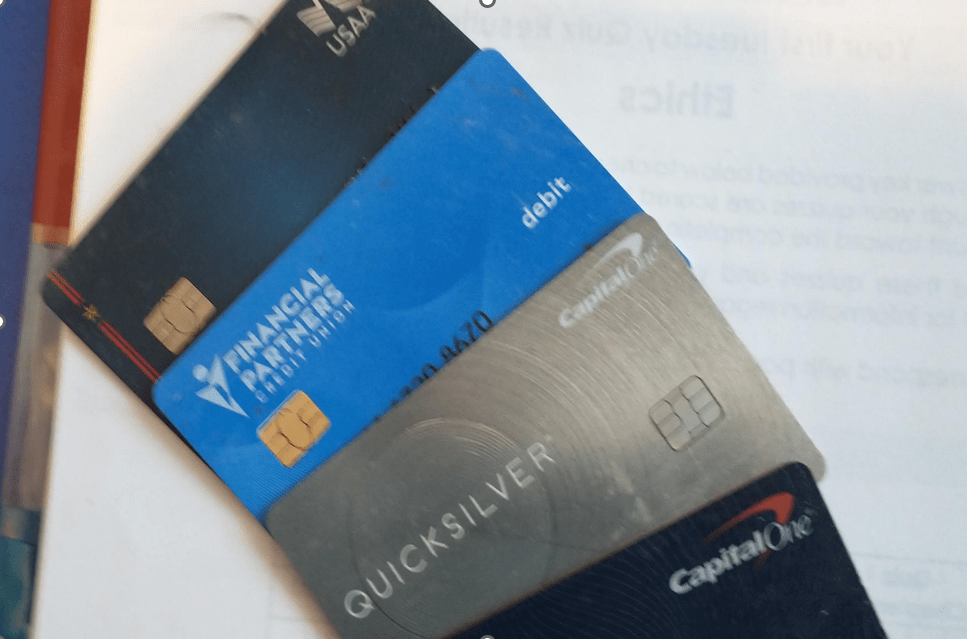
Photo taken by the blog’s author and is free to use when credit is given to the blog.
In the image above, there are a few credit cards and a few debit cards. These types of cards are distinct. They may appear to be the same, but they are very different. A debit card electronically subtracts the funds from your savings or checking account for your purchased goods or services.
Sometimes, a good source may be a family member, but be aware that this kind of loan may strain your relationship. Some people have found that micro lending organizations are the preferred method they use. They can borrow or loan to such organizations. The link below is provided to answer your questions concerning these loans.
https://www.fundera.com/business-loans/guides/microloans
There are many different types of loans available to us today. In and of themselves, they are not good or bad. They are indifferent. The way we use or abuse them is good or bad. Most of us need a loan during our lifetime; when it’s time to apply, shop around and apply for the best ones. Research the lenders and gather data to make an informed decision. Credit can be good. Over time, purchasing a home on credit reduces the percentage of your income you must allocate to the home purchase. You may not lower the amount of money you give for the property, but because of the Time Value of Money, the money you allocate to the loan may be worth less. You can have a smartphone or a smart TV. Even smart cards with their computer chip store 500 times more information than standard cards.

<a href=”https://www.freepik.com/free-photo/emotive-cheerful-shopping-woman-uses-mobile-phone-pay-online-holds-credit-card-stands-yellow-sweaters-hangers_12701431.htm#query=smart%20consumer&position=44&from_view=keyword&track=ais”>Image by wayhomestudio</a> on Freepik
Note: Images on this blog site are from a free source. No image or group of photos are intended to represent the people I serve. I don’t care about Race (that is a politically correct term that I do not like because we are all of the same Race, the Human Race. I prefer the term ethnicity), color, religion, sex, gender, marital status, disability, genetic information, national origin, source of income, Veteran or military status, ancestry, citizenship, primary language or immigration status. I am a service provider for all people. We will all rise together when we band together and help one another. Joseph Erwin is a Real Estate Broker, DRE # O2131799, and a CA general contractor # B 696662. He’s a member of the CRMLS and The East Valley Association of Realtors located in the Inland Empire region of Southern California.
 House 2 Homes
Leave a comment